Sunday, 17 November 2013

Archives........

"ar·chive 
1. A place or collection containing records, documents, or other materials of historical interest. Often used in the plural: old land deeds in the municipal archives.
2. Computer Science
a. A long-term storage area, often on magnetic tape, for backup copies of files or for files that are no longer in active use.
b. A file containing one or more files in compressed format for more efficient storage and transfer.
3. A repository for stored memories or information: the archive of the mind.
ar·chivedar·chiv·ingar·chives
1. To place or store in an archive.
2. Computer Science To copy or compress (a file) into an archive." - Farlex (2013) The free dictionary. Retrieved from: http://www.thefreedictionary.com/archive


Examples of Archives-

  • Museums
  • Libraries
  • Online i.e. Social netwroking sites are archives of our everyday lives. News websites with archives of past news reports.
  • Local History Archives 
  • Special Collection Archives 
  • Film and Photography archives 
  • Textile archives i.e. Trend Hub in Library/ Lee Mills archives (Knitwear).
  • Sketchbooks/ Research Journals- archives of information/ drawings.
Examples of Archives in Huddersfield-

  • Local Library 
  • University Library 
  • Kirklees Image Archive
  • The Tolson Museum-Archives the history of Huddersfield. Archive of Taxidermy. 
  • Textile archives i.e. Trend Hub in Library.

As a practitioner I have built up an archive of all my work from when I was doing my A-levels, to College, to University work. Over the years I have developed skills, researched and documented these findings within sketchbooks, loose sheets, final collections etc. so I myself have an archive as a practitioner. This archive of work allows me to have a reference for future studies, either continuing a project from a previous year  by referring back tot his work or just looking back at it for inspiration, artist reference etc.

If I were to intervene in an archive  it would probably have to be in relation to a building or a museum which had some history to it, a back story, such as the Tolson museum in Huddersfield, which we did a small intervention project on in first year. The building houses collections of both the history of Huddersfield as well as some very weird and wonderful collections of Taxidermy, motor cars, childrens toys etc. I would possibly consider just taking this project on a pushing it further, developing it as I became thoroughly interested in the history of the building and began doing archival research in the local library so as to learn more about the pace. I think I would respond in a very textiles way as that is how I express myself, through my own passion which is textiles, however it would probably be in a very contemporary way, drawing  on the fact and memories of the space.

An example of an artist work which I have recently looked at is Caren Garfen, who exhibited a work at the Cloth and Memory 2 exhibition this august.
Artist whose installation is based on the lives of actual women from Saltaire drawn from the 1891 Census. The installation comprises of vintage wooden reels attached to the wall, each with its own 'memory plaque' label and an 'S' for Salts and Silver, some will also have ribbon wrapped round with hand stitched addresses or researched texts. - Garfen, C (2013) Cloth and Memory 2. Retrieved from: http://www.clothandmemory.com/#cloth-memory-2-participating-artists 


In her work she has intervened in the 1891 Census and has drawn on both the heritage and history of the space she is responding to whilst also delving into the Census of women who worked there and using this archive to produce and form the foundation for her research and final response.


Planning a Literature Review...Sustainable Materials

Sustainable Materials

The research topic I have chosen to look at is Sustainable materials.
Key authors/ Organisations in this field are: 
Authors-

  • Edward Burtynskey- Manufactured Landscapes. 
  • Kate Fletcher- Sustainable Fashion and Textiles, Design Journey.
  • David Buckland- The Art of Climate Change
  • Arran Stibbe and Heather Luna- The Handbook of Sustainable Literacy eds 2009
  • Radical Nature: Art and Architecture for a changing planet 1969-2009-Barbican (2009)
  • R. Horrocks- Recycling Textiles and Plastic Waste. (1996).
  • Andrew Brooks ‘Riches from Rags or Persistent Poverty? The Working Lives of Secondhand Clothing Vendors in Maputo, Mozambique’ From:  Textile: The Journal of Cloth and Culture (2012)
  • Allwood, J.M., Laursen, S.E., Malvido de Rodriguez, C., Bocken, N.M.P. (2006). Well Dressed? The present and future sustainability of clothing and textiles in the United Kingdom 
Organisations-
  • Labour Behind the Label
  • Clean Clothes Campaign 
  • Fairtrade Foundation 
  • Fibre Footprint Sustainable cotton project
  • Victor-Innovatex-Environmentally safe Polyester recycling system.
  • Teijin-Technology Driven Global Group (Japan)
  • Patagoni Recycling Program
  • Ecouterre
  • Perma Couture
  • Rebecca Earley and Kate Fletcher-Ecological Approaches
  • Rebecca Earley-Upcycling Shirts
  • Eden Bayer- Are Mushrooms the new plastic
Artists-
  • Edward Burtynsky
  • Lucy and Jorge Orta
  • Spencer Finch 
  • Radical Nature: Art and Architecture for a changing planet 1969-2009
  • Hyperbolic Crochet Coral Reef
  • Vivienne Westwood & Richard Branson, Virgin Atlantic Uniforms-Vogue.
  • Betty Beuamont-Ocean Landmark
Possible Sub-themes within this topic are: 
Economic Factors 
Social Factors 
Environmental factors 

However these sub-themes all interlink, so to discuss one of them we must briefly discuss them all.

The Literature Review. 
Having never written a literature review before I am quite apprehensive about approaching this, but I have a vague idea of how You might write one. 
A literature review should be a review of key authors/ organisations work within the topic you have chosen however you should be comparing and contrasting their opinions- arguing them against each other in relevance to your chosen question or theme. They should provide a clear and relevant understanding of what your are aiming to prove/ discuss, and should not just be a list of what each authors views or opinions are. 
It should engage the reader and explain what you are trying to achieve and it should provide you with a platform upon which you can begin your argument.

I am eager to begin researching the authors etc. who have already undertaken research in my topic and also to begin planning my question/ theme. 

Sunday, 3 November 2013

Contexts and Research Topics...


For my Theory and context module I have to choose a research topic to address and research in depth, but first I must choose a context in which I want to approach the way I research.
The possible contexts are:

Textile Thinking: a topic that is relevant to your specialism and provides new insights into textile practices.
Archival Interventions: an investigation into an existing exhibition or collection t a museum or gallery, its history and contemporary significance, how it inspires you and the implications for your own textile practice.
The creation of a new or improved textile product or service idea: to help tackle a particular issue or problem.


I think the context I am most interested in is the creation of a new or improved textile product or service idea, as I believe that there are many issues within the textile industry that need to be addressed and I believe that Woven fabrics have a vast range of production issues and problems which I will be able to address if I approach my research topic within this context. I have narrowed my pathway down to this context because as a Contemporary practitioner (soon to be either a designer maker) and a weaver I believe that I will need to be aware of all the issues surrounding my topic and the future of the production of woven fabrics and the current issues we face within the textile industry.

The research topics we have been given are: 
  • Future workplace 
  • Sustainable materials 
  • Archival Interventions 
  • Innovations in Giving 
  • Collaborative Consumption 
  • Well-Being 


All these research topics are based around current issues and affairs already happening within the textiles industry today.
I have chosen to look at Sustainable Materials for my research topic as I know there are already many issues surrounding sustainable materials within the textile industry and also more specifically within weave, for example, shortage of cotton production, unfair working environments for the production and manufacturing of cotton, over usage of water for dyeing garments and yarns etc.

I have specifically chosen this topic as I am a great believer in the usage of sustainable materials and hope to further develop my understanding of the issue and the ways in which we are attempting to overcome these problems for the future.


The methods of research I could use within this research topic as a soon to be designer maker are:

  • Market research 
  • Trend research (approach in a different way) 
  • Textile news 
  • Experimentation 
  • Current affairs 
  • Textile magazines 
  • Books on Sustainable materials 
  • Magazines, Journals and Articles 
  • Big Data 
  • Product research 
  • New technologies 
  • Advances within my practice 
  • Interviews 
  • Communication with companies and designers already addressing the issue 
  • Documentaries 
  • Statistics 


I believe that by approaching my research topic in this way I will better be able to understand a relate my context and specialism together as I will be able to integrate my findings into my current projects and hopefully be able to approach the way i work in a more informed and professional way.


The Brief...

Within my module "Advanced Theory and Context" at university, we have been given a brief which entails us to create an external  reflective blog, where I will reflect on each weeks lessons and address various questions about the different topics within the textile industry. The blog will also need to include information about what I am creating/ inspired by/making within my other modules and any visits I go to throughout the year. The brief stipulates that this blog has to be at least 3000 words, and so what you are reading now an the previous posts are the beginning of my reflective blog.

The brief also requires me to produce a written assignment based on one of the research topics out of a list of topics which is provided to us by our lecturer. The assignment also needs to be 3000 words, with further outcomes of research linked into the reflective blog. Within this assignment I will need to thoroughly explore my research topic, using various types of research relevant to the context I plan on approaching my topic in.

I think this module will benefit me as I think it will open my mind up to the world of textiles from a more ethical, political, and social perspective rather than just the view of a designer. I think it will make me more aware of the problem and research opportunities within Textiles and also prepare me for the dissertation I will have to create in my final year of University.

Tuesday, 29 October 2013

Grayson Perry, Playing to the Gallery - Democracy has Bad Taste


Perry, G. (2013) Democracy has bad taste  [Radio series episode]. The Reith Lectures - Grayson Perry: Playing to the Gallery: 2013 
London: BBC Radio 4.

Grayson Perry has delivered his first of four lectures for the programme 'The Reith lectures' on Radio 4.
Grayson perry is a artistic male cross dresser who expresses his opinions and research through the various modes of making; Pottery and more recently Tapestry. His work addresses the social scene in modern society in a playful and mocking way, which also enlivens and explains how we live now as a nation/ population/ species.
This lecture was recorded in front of an audience at the Tate Modern London, and was about 45 minutes long, with a Q&A at the end.

In these lectures Grayson Perry aims to address the issue of the quality of art. He addresses the issue that democracy has 'bad taste' within the art world. He addresses why some people are infuriated by art and wants to give the average person the tools with which to de-construct and build up their own opinion of a piece of work or exhibition.He also looks at the process of art appreciation and how it becomes a 'quality' piece of work; a piece of GOOD art. He looks at how art is judged and marked against an unwritten criteria by the scholars of the educated art world. Perry uses his experience within the art world to discuss this issue of Democracy has bad taste, and give an art educated opinion upon it. 

In this lecture Perry suggests that art is intimidating to the public, that we are apprehensive about sharing an opinion on a piece of work because we feel we aren't educated enough to understand the arty language being used to describe a piece of work or exhibition. I have to agree with this, I find myself sometimes intimidated by the language that is used to explain and promote a piece of work, to me it is just a jumble of as many big words and sentences as possible to say something that could easily be said in just one simple sentence or paragraph. I agree that the descriptions put you through a sense of 'Metaphorical Sea sickness' and I think it is this which puts a lot of the public off the idea of going to a gallery and having an opinion on an exhibition or a piece of work.

Perry suggests that nowadays arts is just 'Art for Arts sake'. The art world is now a popularity contest rather than looking at the quality or craftsmanship within a piece. The art world is money minded and a piece of art work now is not seen as something to be cherished, but an investment, a lump of cash hanging on your wall etc. To quote the lecture;
“I mean one of my favourite quotes is that you’ll never have a good art career unless your work fits into the elevator  of a New York apartment block” 

should this be the issue? should art not be appreciated for its skill and meaning rather than its money value. I mean who validates art? critics, other artists, teachers, curators, dealers? They all have a consensus and a slid set of rules about what is good artwork. But it is the curators who hold the most power as it is they who choose what to display together, it is they who orchestrate an exhibition to either enhance a particular art work or diminish it completely and cast it away. At the end of the day Perry is trying to get across that there is this battle between what is good art and what is popular, what fits in with the current trends of the population and what does not. That art is only good if enough 'Educated' people think it is. 

The main points I think this lecture was trying to get across are:
  1. Don't feel like a sheep for liking something that is commonly liked or 'trendy' there's no shame in appreciating what you think is good artwork. It doesn't mater what other people think of your opinion, you 
  2. How art is validated and critiqued as 'good art' and the processes of reviews and analysis it goes through to get there. Just because a bunch of important arty people adore a piece of work doesn't mean you have to think its the most amazing piece of work you've ever seen. 
  3. That even though we don't all understand art doesn't mean we cant all enjoy it and have our own opinion on it. We shouldn't be put off by the 'Metaphorical sea sickness' we get off the literacy used to describe the work, we should just enjoy it as it is. You don't have to justify yourself to anyone. 
  4. Art isn't about being popular, its about liking something for your own reasons.
Grayson Perry has opened my eyes a little to the opinions and ways of the art world; how art is chosen and validated and how to interpret art in a less intimidating way. 


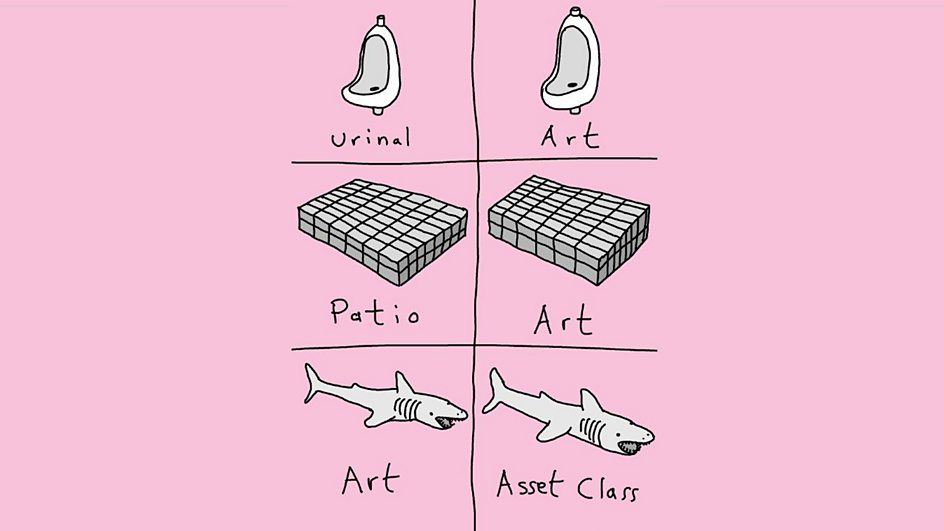
I chose to look at this picture because I think it just really sums up this quote of 'Art for arts sake' that he addresses in his lecture; what is art? why is it art? and how do we understand it etc? I like the mocking tone of this drawing and how it contradicts itself, with the same drawings. It suggests that anything can be art in the modern society and that we need t understand how art is validated and considered good art in order to understand what it is actually about. 


WT Johnsons

WT Johnson's is one of the worlds leading fabric dyers and finishers based in Huddersfield.
We got the chance to visit this mill with the university and we were taken on a tour following through the various stages of fabric finishing. The finishing of fabric is everything; it is what makes a fabric desirable and appealing to the consumer, it is what makes the handle of a fabric have a better drape and feel etc.
WT Johnson's  has been established since 1910 and is its 4th generation of  the same family which all share a passion for textile finishing. They apply and create high quality finishes to a range of fabrics through the use of craftsmanship and innovative technology; they have a variety of modern machinery and also traditional old machinery which is able to achieve a finish that modern machinery just doesn't seem to be able to achieve and they also have a dedicated workforce of over 90 skilled finishers. They provide finishes on a range of fabrics from high quality worsted suiting fabrics to upholstery and specialist safety uniform fabrics.
They run an environmentally friendly establishment, acquiring their water naturally straight from the ground through a bore-hole.
Some of the finishes they offer are: Scouring, Milling, Solvent Scour, Drying, Cropping, Batch Decating, Eko Fast, Dyeing.
The specialist performance finishes they offer are: Cool stretch, Silver Shield, Nano bloc, V.V. Finishing, Bespoke, and a Luxury Merchant Finish.
Below are some of the images I took whilst on the tour of the various stages of finishing.
                                                 
WT Johnson's was a great place to visit as it informed me more of the processes that we can apply to fabric after it has been woven to create a certain feel or handle to the fabric. It opened my mind up to the world of finishing and I am keen to find out more about the processes as I progress through the second year.


Colne Valley Museum

This weekend I decided to visit the Colne Valley Museum in Cliff ash, Golcar, Huddersfield. The Colne valley museum is based in a row of ex-weavers cottages, which were built by a family of independent cloth manufacturers, the Pearson's, whose relatives still live in the village today. The row of 3 cottages are now all  owned by the Colne valley museum, and they hope to develop the newly acquired space into model bedrooms, of how the weavers would have lived there.

What I  particularly liked about these cottages was their traditionalism; they represented the very old craft which is weaving and how the family of cloth manufacturers would have lived within the cottages and where the various stages of weaving would have taken place. The weavers cottages are split up into stages, the lower level (below image) would have been where the family lived at all times. They would have bathed here, cooked and spent the majority of their free time all in this one room together which is incredibly hard to imagine in today's society. 


I found it to be an incredibly informative visit as I was also able to go up stairs and learn how wool would have been spun both on spinning wheels and also on the 'Spinning Jenny'. Seeing the spinning jenny in action was very inspiring and amazing to see as obviously as fibres are now mechanically spun into yarn through computerised machinery. Below are the images of the spinning wheels and the spinning jenny. 

 
The staff at the museum were very chatty and dressed traditionally which I think only added to the idea of being transported back into the time during the 1800's when weaving families lived here. The entire museum is a homage to the craft that is weaving as well as offering  displays of a cobblers, where sometimes there is actually a cobbler making shoes however he was not the upon my visit. The looms there are also still being used, and on the smaller loom in the spinning room they allow visiting schools to spin thread themselves and also to have a go at weaving on the old wooden looms. Below are images of the looms and the warping frame.
 

The visit to this museum really opened my eyes more to the traditional ways of weaving and also an insight into the heritage of weaving in Huddersfield. 

The Great Northern Contemporary Craft Fair

I got the opportunity to go the the Great Northern Contemporary Craft fair in Spinning fields, Manchester. This was a great chance for me to develop some market research on what products are developed and are being sold within the weave industry by established and newly emerging designers. 
At the show it was a great chance to network with weave designers and actually talk to them about their craft, how their products are made/ manufactured and also how they advertise and promote their products within the industry. It was a great way to make contacts in a more relaxed and less official environment and all the designers there were incredibly friendly and easy to talk to. I also got a lot of ideas on how to present my weaves in a more design orientated manner, to enhance them and make them more appealing to the buyer. 
The craft fair was a brilliant, informative, but very cold day out, and I would definitely go again should the opportunity arise, as it was an amazing insight into the textiles industry and the variety of craft within the UK. Below are just some of the images I took of the work on display which I particularly liked.
There were weave designers there such as  Margo Selby, Theo Wright, Sarah Tyssen, Helen Foot, Lydia Williams and Jennifer Holsey.  

Draped Hope JacketVintage Jive Armchair
Diamond Stripe design scarvesGale Warning scarves
'London' scarf

One of the  displays I was particularly taken with the work of Katie Stainer who creates Contemporary origami. Her origamis are very innovative and creative and just seemed so different to anything I had ever seen as an actual product. 
Below are the images of some of her intricate designs. 

Origami Sunburst 'Use Your Map'

All images are from:
Great Northern Contemporary Craft Fair. (N.D.) Retrieved from: http://www.greatnorthernevents.co.uk/

Sunday, 20 October 2013

Design to Minimise Waste

Design to minimise waste, well we've never really considered this in the past but as our climate continues to change due to waste strain we put upon it, we begin to realise that each one of us needs to do our bit. In today's society people are slowly becoming more aware of their own economical footprint, I know this because recycling and the idea of 'waste management' has been drilled into my generation persistently for the entirety of my education. It is through education and the press that we encourage and promote the idea of waste and recycling.

On the textile toolbox website the fashion industry is split up into two main types of fashion waste; Pre-consumer and post-consumer.
Pre-consumer waste consists of the lack to cut patterns with the idea of no waste in mind and also all the excess waste created in the manufacturing countries, as no thought is put into the cutting or design patterns. This is a big issue as we continue to fill up land fill sites with non bio-degradable materials, or even burning excess fabrics, thus polluting the atmosphere further. However if we were to put these excess scraps of material back into the fashion industry perhaps we could change the face of fashion waste. Designers are partly responsible for the increasing amount of fashion waste as they fulfil the constant need to wear the next trendy outfit and meet sales targets etc. Perhaps more thought should be put into the creation and technical developments of a design such as the cutting patterns, using materials that last longer and have had more time taken on them when choosing fibre types etc. like in Alabama Chain, they only produce what they need, they makes garment s to order and don't make or have any unnecessary waste.

As consumers I don't think we recognise the amount of waste we produce through the current industry of constant fast fashion, we merely care about being on trend, wearing what the celebrities are wearing, basically being 'cool and fashionable' and we dont care about what ahppens to our clothes once we bin them. However we need to be more aware of how we recycle our clothing, but this is not a new thing. Vivienne Westwood has been encouraging the idea of recycled clothing and re-inventing what you wear, basically D.I.Y, e.g. The 'punk' era. Vivienne Westwood as an example recently re-design the uniforms for Virgin atlantic airline staff, creating trendy fashionable uniforms but out of recycled polyester yarn that originated from plastic bottles and canvas created from reused roadside banners and leather cut-off's.
Marks and Spencer's are also one of many companies who are now promoting consumer recycling within their fashion department, encouraging their customer to bring their worn out and unwanted clothes back to the store so that the company can recycle them themselves. Encouraging an easy way for consumers to get rid of  and recycle their clothing.
The state our fashion climate is in though isn't due to the manufacturers or the designers, it is a constant cycle of the WANTS and NEEDS of the public. There is such a high demand for faster fashion and new products, that companies barely have the time or resources to start to think about a more waste friendly way of designing.

In my opinion Design to minimise waste is the future collaboration that both the designer and consumers need to think about together, to reduce the concept of fast fashion and develop a mutual understanding of how we can reduce the waste impact of both pre and post consumer consumption. We should be creating clothing with more care and a quality to them which will make them last longer, like many years ago when you would go to a dress maker for  a dress, and a tailors for a suit etc. Waste was less back then because we didn't have such a competitive fashion industry or have to cater to so many new trends and styles, you had several well made and crafted outfits, which you could adjust according to the time of day or event, there was no need for having mountains upon mountains of clothes. I think where the fashion industry is concern we need to start thinking a little bit more backwardly, and promote the smaller companies who create well crafted products that last much longer, rather than these convenient fashion stores which churn out new products on a weekly basis. It shouldn't be waste for the sake of waste. It should be minimised waste for the sake of a long lasting and well crafted product. It is our responsibility as future designer to incorporate the environmental impact of our products in the design process and also to make the consumer realise the  impact fashion has on the world.

Examples of Designers who think about the waste side of fashion:
Zero-waste garments by David Telfer, 2010. Photograph by Thomas McQuillan, courtesy of David Telfer

Zero-waste garments by David Telfer, 2010. Photograph by Thomas McQuillan, courtesy of David Telfer

Tefler, D photograph by McQuillan, T. (2010) Zero Waste Garments. Photograph. Retrieved from: http://www.textiletoolbox.com/posts/design-minimise-waste/


Vivienne Westwood
Vivienne Westwood's women's Virgin Atlantic uniformVivienne Westwood's men's Virgin Atlantic uniform

Alexander, E. (2013) Westwood designs Virgin Atlantic Uniforms. Retrieved from: http://www.vogue.co.uk/news/2013/05/02/vivienne-westwood-designs-virgin-atlantic-uniforms


Saturday, 19 October 2013

Textile Futures Research Centre


Textile Futures Research CentreTo summarise what it is, the textiles futures research centre is a group of experienced designers and researchers who pursue a more sustainable way of producing materials and textiles for the future. 

The researchers are a community which consists of  PhD researchers, Post graduate and under-graduate textiles students, who all participate at one of specialist research centres   which are based at the two design colleges in the UK; Central Saint Martins and Chelsea and also The University of Arts London (UAL). It is here where their research is performed with the shared final vision of a sustainable textile futures.
The researchers drift between the three different stages which the TFRC examine future materials, these stages are:- science and technology,sustainable strategy, and well-being and social innovation. Researchers can drift between different projects extending their knowledge and striving to develop more understanding on the future of sustainable materials.

TRFC has a breadth of resources and experience in the development and usage of textiles and materials based research projects. They work with people in the various stages of education and also in collaboration with other companies, for example TFRC offer consultancy services, which involves trend briefing, Product development prototyping and sampling, sponsering student projects, knowledge transfer partnerships and contract research. They also offer Research as collaborations with other companies/ clients, giving them access to conducting research that is considered too far out to be viable.

Examples of some of the projects they have done:
"Harnessing Nano-Technology to combat climate change

Using a multi-disciplinary approach to design effective adaptation solutions for the built environment

  • This is a collaborative project between; Stanton William, Atelier Ten, Nanoforce and Central Saint Martins College of Art and Design. 
  • The Focus here was to use the new Central Saint Martins Campus in London to explore the potential retrofitting of high performance and nano materials to help combat the effect of climate change, in this case, help reduce the effect of hotter summers. 
  • Increased temperature will impact on the passive cooling capacity of the building, and the team explored emergent nano technologies that could be adapted and further developed into materials for the built environment for the years 2030 and beyond.http://www.tfrc.org.uk/research/harnessing-nanotechnology-to-combat-climate-change/)
Textiles Futures Research Centre. (N.D.) Harnessing Nano-Technology to combat climate change. Retrieved  From: http://www.tfrc.org.uk

What I particularly like about the above project is the environmental impact of it. Protecting the environment from the effects of climate change via the use of technological materials which will help in the effect of keeping buildings cooler in the hotter summers.
I think the Textiles Futures Research Centres is a great community who are involved in both the futures of textile materials in all aspect of fashion and textiles and who enable other companies to also share an interest and perform research on the concept and idea of future materials.


Thursday, 10 October 2013


 Drawings I created at the mill in response to the work by Diane Harrison.


One of the works I particularly liked at the exhibition was an installation called ‘Handkerchiefs’ 4.5m x 2.5m by Diane Harrison. This piece of work is made up of over-dyed and discharge printed handkerchiefs, laid out in the pattern to follow the flag stones on the floor. 
What Inspired me so much about the piece is that all the over-dyeing and discharge printing, has embedded itself into the handkerchiefs, like the marks/ memories on the flagstones that had been left from years ago by the workers in the spinning room. I think that each tiny stain left in the weave of the handkerchiefs is like a mark on the surface of the flagstones, and the way they have been presented only enhances the connection between the flagstones and Diane Harrison’s work.